
Postwar perspectives
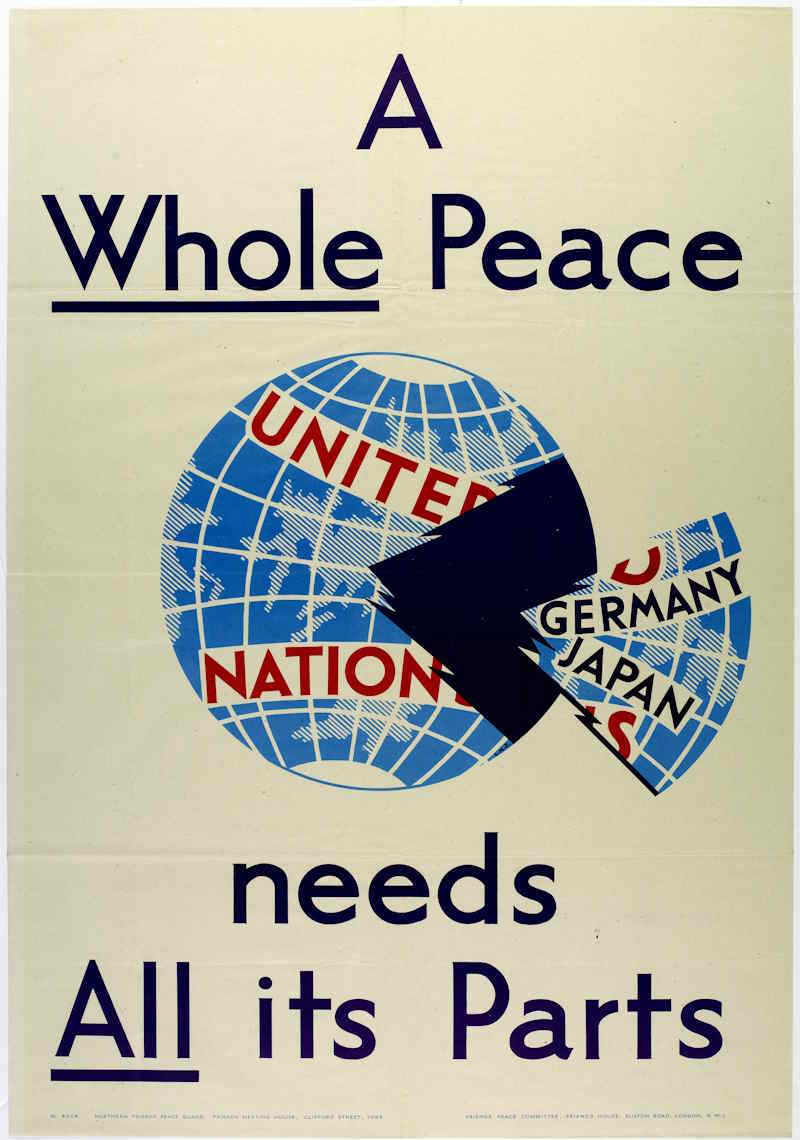
We are at the beginning of a series of 80th anniversaries: the end of the Second World War in Europe, the attacks on Hiroshima and Nagasaki, and the ending of the war in the far-east. Friends today are being challenged to consider how to respond to the rise of populist nationalism and authoritarianism, renewed wars of aggression and expansion, the breakdown of the post-1945 international order, and rising anti-migrant sentiments.
Whilst only we can speak to our condition and situation in the world as it is now, we might reflect on the responses of Northern Friends to events 80 years previously. We are republishing excerpts from three documents from that time: the 1945 NFPB Annual Report, the statement on the dropping of the atomic bomb on Hiroshima and Nagasaki, and the 1946 NFPB Annual Report. In sharing these now, we recognise that the language, perspective and perhaps even the theology are those of earlier generations, and some of this will grate. The world and we, as a Society of Friends, have changed and been changed by events, insights and experiences since then.
The documents reflect the deep concerns of Friends for the postwar world, its recovery and the future of international cooperation. They rightly perceived the threat of great-power military power, and the importance of international cooperation and reconciliation, in ways that seem particularly pertinent for our current world. In this sense, Friends then spoke what is still our truth – military might and war are not the answer and in the end antithetical to a peaceful world and a just international community. Again we find ourselves, through our work, urging a radically different way forward. Cooperation over competition, human goodwill rather than military might as the basis of security, genuine service rather than military coercion.
From the NFPB Annual report for the year ending 31 August 1945
The year under review has seen the end of the second world war. It is now widely recognised that in Europe the policy of Unconditional Surrender was responsible for a considerable lengthening of the war. The result has been, not only to increase unnecessarily the total material devastation, but to bring about a complete social and spiritual collapse, which is presenting the victorious allies with problems immeasurably greater than any they have faced during the last six years.
At the time of the collapse of Germany it appeared likely that the war in the Far East would follow a similar course – a prolongation of the war by adherence to the policy of Unconditional Surrender resulting in disintegration on an even greater scale than in Europe and leaving a human problem far beyond the capacity of the victors to solve. The Board was deeply concerned with this aspect of the Japanese war, and our concern was endorsed by Meeting for Sufferings, so that a message urging the need for stating peace terms was sent officially to British statesmen at the time of their meeting at Potsdam.
But the frightfulness of war, progressing from the bombing of military objectives to obliteration bombing and the use of rocket bombs, culminated in the invention of the atomic bomb. Its destructive power was of such magnitude that Japan immediately surrendered. The social fabric of Japanese life has not collapsed to the same degree as that of Germany, but the atomic bomb has raised new and vast moral problems which throw into sharp relief the futility of trying to establish peace on the basis of military might.
There is an immense task confronting Friends in bringing the public to realise that war-mindedness can never bring the peace they long for and in helping them to realise that peace can be secured only as the fruit of the spirit of peace which aims first of all at bringing their late enemies into the family of nations and at working with them and with our allies to build the common life of the world.
During the year a new world organization came into being by the signing of the United Nations Charter at San Francisco. The Charter shows some improvement on the original proposals as outlined at Dumbarton Oaks*, particularly in the establishment of a Trusteeship Council and in the strengthening of the Social and Economical Council. These two organs give a ray of hope that peaceful relationships may be more firmly established, and pacifists have a field of activity in mobilising public opinion behind them. They must see that the Trusteeship Council does not act as a cloak for Imperialism and that an increasing number of international functional agencies is established collaborating under the authority of the Social and Economic Council. But the main trend of the World Organization is a retrograde step from the League of Nations, which, with all its faults, was an attempt to apply a moral sanction in international affairs. The new World Organization is rooted in power, expressed particularly in the determination of the Great Powers to maintain vast armaments to impose their united will on the rest of the world. With this, there is associated the intention of retaining military conscription permanently. We must do our utmost to remove this threat of conscription, for progress towards peace is impossible if young men everywhere are subjected to a discipline which perpetuates war-mindedness and trains them to regard men of a different nationality as potential enemies.
* https://www.doaks.org/newsletter/news-archives/2015/the-dumbarton-oaks-conversations-1944

Statement by the N.F.P.B. on the Atomic Bomb, drafted September 1945
The release of atomic energy for destructive purposes is recognised as opening a new epoch in human relationships. Much has been said about the only two alternatives now before mankind – complete self-annihilation or abolition of war; but the deeper implications of the new position have been largely overlooked. It rests with those who believe that the Christian faith is the only way of bringing peace to the peoples of the world to make these implications clear.
We are concerned to stress the urgency of the present situation, and in particular to emphasise three aspects of the new development.
1. The moral disintegration resulting from all war has reached its climax in the atomic bomb. It is the final atrocity reached progressively by way of the destruction of the Mohne and Eider dams, obliteration bombing and the attacks on Southern England by rocket bombs. These atrocities will fade into insignificance before the bar of history in the light of this last and greatest atrocity. Mitigation can be gained only by a deep and searching repentance. But repentance is not merely a matter of words or even of restitution. It must be manifested in a total renunciation of power politics, with its inevitable recurrence of war, and a determination to frame a foreign policy in terms of the service of mankind.
2. No scientific research can be carried on except under conditions of freedom; but the ultimate result of research on the structure of the atom, the atomic bomb, shows the immorality arising when freedom is divorced from responsibility. Peace and freedom are inseparable, but unless we proclaim the need for a sense of responsibility, both to God and to man, with as much fervour as we extol freedom our civilisation will end not in peace but in licence and chaos.
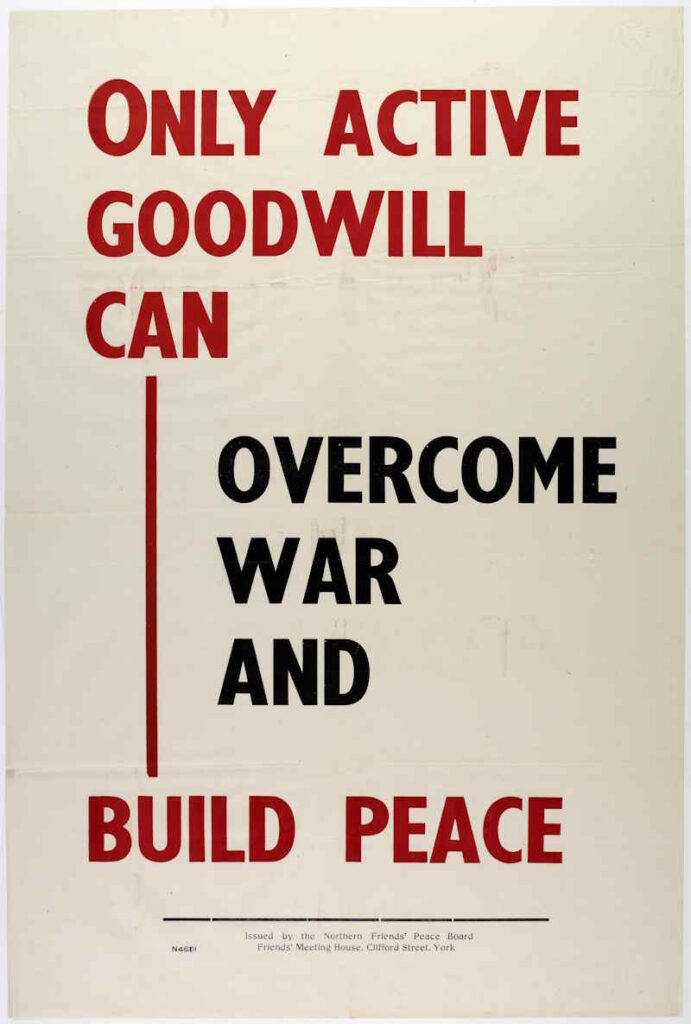
3. There is the temptation to try to guide people into the way of peace by the threat of the alternative, total destruction. But if we do this we deceive ourselves. Fear of what it will bring has never prevented war. There is in man everywhere a courage that scorns fear. Only active goodwill, born of justice and a determination to share good things can overcome war and build peace. America possesses enough atomic bombs completely to destroy all Britain, and she could fly them here in a few hours. But this does not frighten us because we know that between us and America there exists a spirit of Goodwill. Let us demand from our government that they consistently follow that policy which will build goodwill between all peoples. Let us show that we care about the standard of living in other countries as much as in her own, that we are willing to sacrifice for the good of the whole. Thus will come real peace, which is born of a spirit of cooperation in the whole family of God.
From the NFPB Annual Report for the year ending 31 August 1946
The period under review is the first complete post-war year, and during this year problems have emerged of a more complex character than those of the war years. We are witnessing the evils of the war spirit – ruthlessness, selfishness and the general relaxation of moral values – flooding every field of human activity. In the international sphere the achievement of victory has dissolved the link binding the United Nations, and their different policies emerge as obstacles to co-operation and engender mutual suspicion. The United Nations Organization has been established and many of its organs have come into being, yet progress towards a world community is hampered by the failure to reach agreement on any of the major problems of world affairs. By a series of compromises the ex-allies are working out the details of the peace treaties with the smaller European ex-enemy states, but consideration of the treaties with Germany and Japan has not begun, and the friction apparent at all conferences of the Great Powers has induced much talk of, and preparation for, the next war. Here is an urgent need to encourage men and women everywhere to look beyond their selfish interests and to create the moral opinion in which the abrogation of national sovereignty and the acceptance of a wider form of government may develop.
These critical times serve to emphasise that work of reconciliation must be the main concern of any peace organization or peace lover. We are profoundly thankful that progress towards reconciliation has recently been made in India and in Egypt, but much still remains to be done there, while in Germany, Palestine and other places developments since the end of the war, by deepening the sense of bitterness and frustration, have made reconciliation increasingly difficult.
The educative work of the Board is to lay before Friends and to help them to lay before the public a line of policy both national and international, which translates into practical terms this work of reconciliation. The needs of the world demand a departure from the pursuit of power politics, in which all other considerations are subordinated to national interests. In a world whose parts are in fact interlocked, world community is essential: and this can be achieved only through co-operation and moral leadership. Christianity is based on hope, on a belief that we need not despair when faced with the economic and political problems of this world. Coming to specific instances, our work is on the one hand to spread knowledge of the value and importance of such international agencies as the F.A.O., U.N.E.S.C.O., etc., and on the other to work for a removal of such sources of friction and suspicion as the de-industrialisation of Germany, the continued holding of prisoners of war under semi-slave conditions, and the continuation of conscription and other implements of military power.
Categories Challenging militarism, Human Rights, peacebuilding, Quakers, Sustainable security